Friday, 14 October 2011

If it's not broken...

...please don't try to fix it! 

As those of you who follow the "la Bricole" forum are probably aware, the site has been down for about a week now.

Although the site had been running just fine, Forumer, the people who host La Bricole, decided that they would migrate their forums to a new server, and La Bricole was among the first batch to move.

Well, it appears that those responsible for doing it have had more than their share of problems trying to get it up and going.   

Forumer hasn't been all that communicative about what exactly the problem is, or when we can reasonably expect the site to come up again.  But clearly someone in the tech team must be a descendant of the guy responsible for keeping that bridge up for the French army to cross during their retreat from Leipzig.

Anyway when- indeed if- it is ever up again, I'll post it here.
*****

In other news, for those who haven't noticed yet Sada has posted the first pictures of his Perry plastic French, and very tasty they look too!  What with the new plastics on or coming on the market, and the recent releases in metal by the Perry twins, he also seems set on doing Russians.

We have already been tentatively discussing the possibility of a Borodino scenario for the bicentennial in 2012, and a scaled-down Salamanca re-fight is also a definite possibility.


Sunday, 9 October 2011

Battle Report, and Heavy Losses


I've been keeping my hands full over the past month or so with a number of projects on the gaming front.  Since my last post, our club has played both a Napoleonic and a WW2 game.  

Today I'll post a belated report for the the Napoleonic game, a real nail-biter that once again saw us merrily ignore the brigade morale rules and fight bitterly to the last unit.  
This time I was playing with a Russo-Prussian contingent, and along with the British we managed to beat off a superior French force assault on a town.  But only just!

The scenario was forced upon us by the fact that Matt had called that morning to say that he would not be able to make it as he was feeling ill, so that left us without all his British/ Allied forces.  

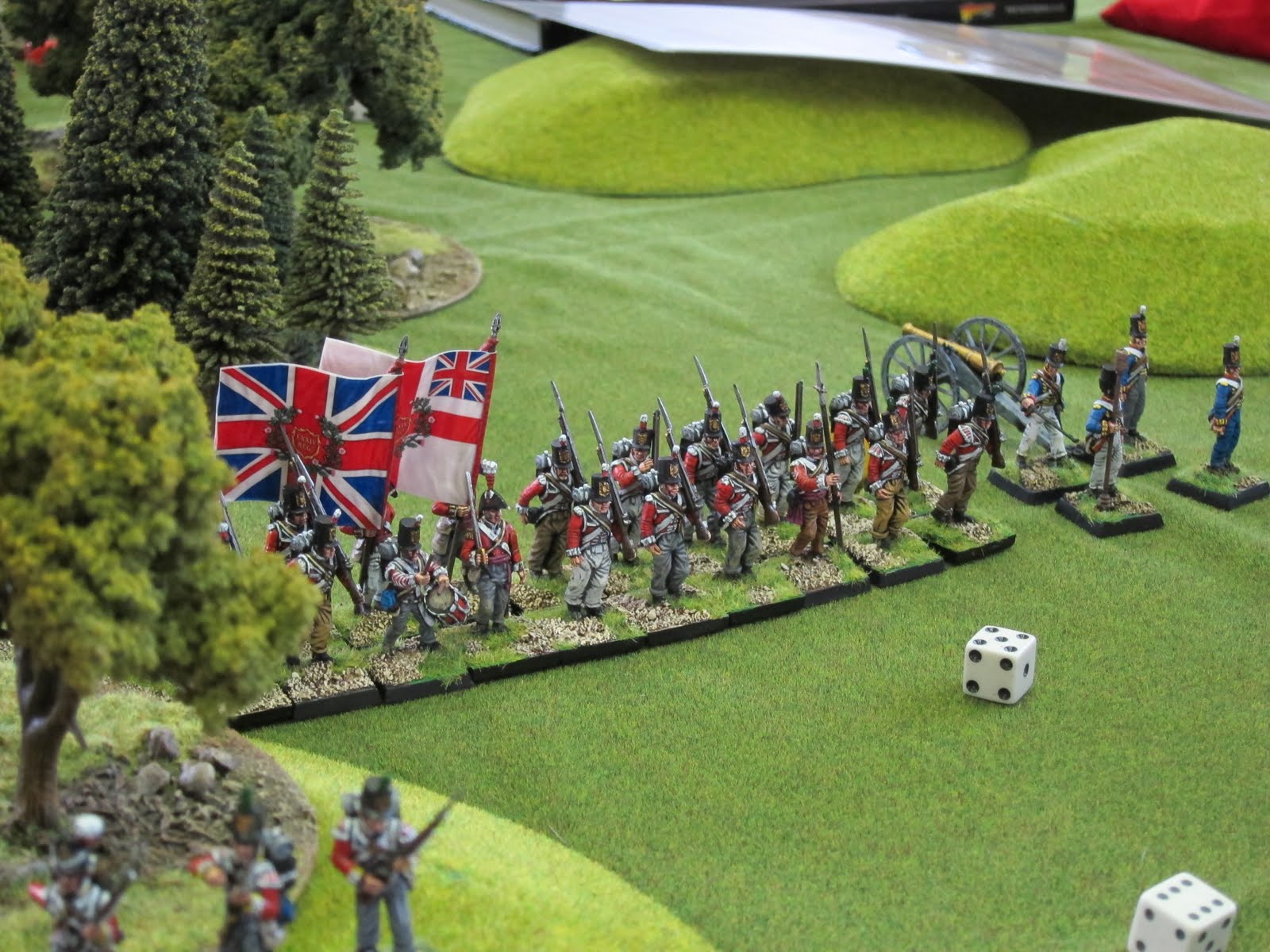
Fortunately, Rod had shown up with his first painted units for Napoleonics, some very nicely done British infantry along with a company of the 95th Rifles and a single gun.  Achilleas- our brushman extraordinaire- had bought his French horde along with a unit each of Prussians, Russians and British.  I was able to throw in my Russian horse artillery battery, so I took command of the Russians and Prussians defending a village on the right with the British aligned on the left flank.

The French we had available to us would have badly outnumbered the allies, so we decided not to field my 28e Légère (no doubt still smarting from losing their Eagle last game), and not to give the French any artillery.  This was to make their prospects of victory immeasurably more difficult.

The French objective was simple, to take all the buildings.  Pete and Achilleas were the French,  Rod and I the Allies.  Rules were, of course, Black Powder. 

We had Pete's gorgeous buildings to fight over, along with some resin models I had brought back with me from my recent trip home to Vancouver.  I bought these back in about 1985, so it was nice to see them getting some use again.  They are smallish 25mm, so work well both with our Napoleonic games and with our 20mm WW2 games.

One thing I didn't bring was my trusty new camera, so I had to resort to the less-than-ideal camera on my cellphone.  That, plus poor room lighting that day, means the photo quality isn't what it could be.
The French enter the field.  They were to dice to see when they arrived on the battlefield.  To the horror of the allies, both forces came in on turn one!
Frenchies coming out of the mist.
The forces of Liberty and Freedom deploy.  The Prussians on the right were to garrison the buildings, and held out against Pete's assault for far longer than I dared to hope.  The Russians were to prove the battle winner!

"My word, Carstairs, there are rather a lot of those garlic-munching chappies out there, what?"


Pete goes straight for the jugular, and moves quickly up the village (he rolled well and got in an extra move- gulp!)
The French grenadiers try a flanking move...
They are in a position to attack the flanks of Rod's British, or to wheel left and get the Russians.
They go for British, leaving the Russians free to exact dreadful retribution!  First blood to the Czar.

Meanwhile, on the Allied left...
The battle on the left was a real see-saw action, and saw the French thrown back once before bravely giving it a second try...
The immortal 57e de ligne plunge into the attack..
...only to be routed, taking another two battalions with them.  This was the first ray of hope for the otherwise extremely hard pressed Allies!
Back to the village, and la marée française washes up against the stone barn and tower.  
The barn was held by the Prussians, who managed to throw back at least three separate assaults.
The Russians were in reserve, ready and willing to die to the last Pommeranian.
Finally, almost out of ammunition and having had taken heavy casualties, the Prussians break after an epic defence.
Their flight exposes the Russian licorne whose crew is soon shot down.
But the French have been exhausted in the fighting, and the Russians do what they do best- go in with the bayonet!   We play it so the Russians automatically pass their first break test, which makes them an army to be reckoned with.  

The battalion sweeps away the Swiss, and manages to stave off defeat in the village as the supporting units pull back.
"URRAH!!!"
On the left flank, Achilleas found out how useful the "Follow me" rule could be!  
The British lose one battalion but not before destroying the French cavalry. 


At this point, with fewer and fewer manoeuvre units to worry about the game started moving very quickly, so that there was no time to take many pictures!  It ended with the sole surviving British- an artillery piece and the commander- racing towards the right flank where the Russians had holed up in the chateau.  The British gun was great at slowing the French advance due to disorder hits, and without artillery themselves, the French found it hard to deal with infantry in the buildings.  

Steady attrition and failed break rolls saw the French reduced to a single unit, which made two assaults on the chateau.  On a third attempt, they too finally broke!  

For Czar, der König, His Britannic Majesty, and Freedom!
An Allied win, in pure Don Featherstone style with a handful of survivors still standing. "A close run thing" doesn't come anywhere near describing it

*****
Now, I did mention heavy losses.   The biggest loss is that we are losing Achilleas.  After long consideration, he has finally made the decision to move back to Greece.  
Achilleas has been a real prime mover in our group, and has been all you could ask for as a gaming partner.  Of course, he is an amazingly talented painter (as pictures both here and on his own blog have testified), and like the rest of us he really values the aesthetics of  wargaming.  

On the tabletop he always plays for the win (usually at the cost of a legendary wastage of horseflesh!), but above all he is a great sport and a real gentleman who knows what gaming is primarily all about- the enjoyment of shared interests with like-minded people.

Thanks, Achilleas, and best of luck for the future.  You'll be missed, and should you ever decide to return there will always be a place at the gaming table waiting for you.

As can be imagined, this sparked a crisis here with the West Tokyo Wargamers (Napoleonic Branch), as his collection has accounted by far for the largest share of the French army.

However, all is not lost.  At this point it's looking likely that the rest of us are going to chip in for a painted brigade from Mabuhay Painting Service (MMPS), which will give us a decent nucleus of  a French force while we can slowly add extra units at a reasonable pace.  Rumour has it that Matt is even to work on Neapolitans!

Also, it looks as if Sada- he of the exquisite Napoleonic ships posted here a while back-  is about to jump into Napoleonic land warfare too, and he has been working on a box of Perry French.  He already has some amazingly painted 15mm Napoleonic miniatures, and given his superb modelling and painting skills, these will be something to look forward to, I'm sure.  And it will be great to have a Japanese gamer on board.

So rest assured, Napoleonics will continue to flourish here in Tokyo.


Monday, 15 August 2011

Last Stand at the Chateau Pignon, 1813, Pt. 2

Or, size isn't necessarily everything!  Continuing on from the last post. 
Outnumbered, surrounded,  a once-in-a-lifetime target, and you roll three "ones".  
Don't you just hate it when that happens?

The small French garrison at Chateau Pignon has already been described.  The 28e Légère is deployed to the rear of the redoubt in column, with a small unit of skirmishers on its right.  In the redoubt is the French  6pdr.  To the left of the redoubt is the 69e de Ligne in column, although it soon formed into line.

The much more numerous British had the following forces at their disposal. 

Division Commander: Lord Benjamin Breeg (Command 8) - Matt 

Darling's Brigade: Lord Henry Darling: (a coward!  Command 5, Timid and Hesitant) -Matt
  • 45th Foot (Nottinghamshire Regt)
  • 5th Foot (Northumberland Fusiliers
  • 60th Rifles
"Is that you, Darling?" Matt's 5th Regt. of Foot- some very nice conversions with Perry and Victrix figures
Strongbow's Brigade: Gen. Sir Septimus Strongbow (a very decisive leader rated 8.  He could re-roll failed command rolls, but if these in turn failed, they would count as a blunder)  -Pete
  • 74th Foot
  • 88th Foot (Connaught Rangers)
  • Royal Artillery (1x 9pdr. gun) 
In reserve, the 14th Light Dragoons under direct command of Lord Breeg.
The 14th Light Dragoons.  These were to enjoy a simply capital spot of hunting today, eh, what?
With numbers like these, victory was only a matter of time.  The challenge of the British players was to see just how long it would take them to overrun the French position.

The British sagely avoided the meadow in the centre of the table, and which was protected by the guns of the redoubt.

The column on the left advanced slowly under its hesitant commander, and most of the time it required a direct order from the general to advance them at all!  
"Move, Damn your Eyes, Sir"
The 5th Foot led the advance.  This was their first time in action, and they were not to disappoint their commander.

 
Meanwhile, the British right advances steadily along the right side of the table.  The 74th Foot- a consistently unlucky regiment- led the advance over a hill-dotted terrain, while the 69e de Ligne waited patiently behind a hill that rested on the left of the redoubt.
All the while the 5th & 45th regiments of foot continued to advance oh-so-slowly up the left side of the valley, while the French piquets- a small detachment of voltigeurs- attempt to enter some woods so that they can snipe at the flank of the British advance.  However, they fail to reach the woods in time, and the 60th Rifles get there  first- and in greater numbers.  

The Rifles opened a galling fire on the picquets, who hung gallantly on in an exposed position before grudgingly giving ground, eventually retiring inside the redoubt.

At this time H.M's 45th Foot, a regiment with an illustrious record in our games, clearly decided that it had done its lion's share of the fighting for a while, and that it was time for the new boys of the 5th to earn their spurs on their own.  They pretty much stayed put for the rest of the battle.

The 14th Light Dragoons were ordered to advance through the infantry to take a position at the top of a hill next to the Chateau (each unit needed a roll of 4+ on a D6 to avoid disorder, and bugger me if they all passed!),  and they soon found themselves in a position to charge down on the flank of the French position, set on seeing off the French cavalry. 

The 14th's bugler sounded the charge, and as they launched themselves down the hill, the regiment was promptly charged in turn by the 7e Chasseurs à Cheval.  This was the start of what was to be a see-saw battle that saw both sides draw off only to charge each other again.  

All this horseflesh milling about perilously close to their flanks forced the 28e to form square behind the redoubt, as the last thing the French wanted was to have the Light Dragoons in their rear.
On the right, the British continue to advance slowly through difficult terrain towards the 69e, and there is some ineffectual skirmishing as the 74th reaches the top of the hill. the 69e advances to close range, and gives them a volley that causes few casualties, but disorders their formation. 

As the 74th fall back, the French choose to retire behind the safety of the hill.  The commander is very aware of the British 9pdr. that is attempting to deploy at the edge of the meadow.

Disaster for the French, as the 7e Chasseurs à Cheval once again counter-charge the by-now-rabid 14th Light Dragoons, but this time, having received hits beyond their break point, they are forced to take a test- and fail. 
Wipe that grin off your mug, Matt!
This leaves the French right flank exposed to a combined attack from both infantry and dragoons.

The action intensifies on both flanks.  The 60th Rifles attempt to charge the redoubt directly from the woods, but are held back by their hesitant commander.  The 5th Foot advance to the hill from where the dragoons had charged down into the French flank, and await their next orders.

Back on the right, the 74th are the victims of a command blunder, which sees them ordered to form up to the left of the wooded hill where they had been engaged with the 69e.  This leaves space for the 88th Foot to advance and to attack the French infantry, but it also directly exposes the wretched 74th to the waiting guns of the redoubt.
 
The French artillery are thus presented with a fantastic target at close range...
Oh, boy, oh boy, oh boy oh boy (drool)....
...and promptly roll three "ones". Merde!  Meanwhile, after an exchange of volleys with the 88th Foot that saw casualties on both sides,  the 69e charges the Irishmen.  They fail to break the redcoats, but once again both sides retire to lick their wounds.  Still the French hang on...

On the British left, all hell breaks loose. There is confusion over an order to the 5th Foot; as he becomes increasingly frustrated with his cautious brigade commander, its colonel chooses to interpret one of Darling's characteristically vague orders for a tardy advance as an order to charge the enemy at once! 
Now off the leash, the 5th charges exuberantly straight down the hill right into the hapless 1/28e, who are still in square as the 14th Light Dragoons reorganize themselves after routing the French cavalry.
The melee between the two is vicious.  Despite all the disadvantages of having to fight in square (two dice against six), the French make a fight of it in their efforts to prevent the redcoats from entering the redoubt.  

Things are looking grim for the French, but they enjoy some success on their left.  The 74th decide that the best way out of their exposed position in the meadow is to charge the redoubt directly, but blasts of canister from the French gun proves too much for the weary Glaswegians, and they break.
But the end is in sight.  After a heroic struggle and heavy casualties at the point of the bayonet, the 28e breaks...
"Sauve qui peut!"
They leave behind their dead, wounded, and the regimental Eagle which is seized by a plucky young officer of the 5th.  Thus to the victors, the spoils: a French Eagle, the ultimate battlefield trophy, and a badge of honour unique for a regiment celebrating it's combat debut.  So much for "newly painted unit" syndrome!'
"For Good King George and Merry 'ol England!"
Shortly afterwards on the French left, one last bayonet charge from the 69e is also repulsed, and they too finally break and leave the field.   This leaves the British field gun free to open up on the redoubt, causing casualties to the crew and disordering the gun.

The last act in the sorry drama is performed by the ubiquitous 14th Light Dragoons.  They charge into the redoubt, cutting down the hapless gunners there and taking the French commander, GdB Bouillon-Cantinat, prisoner.    
"Okay, we'll call it a draw..."
The British are successful, but the French went down fighting!  A small, but hard-fought and memorable engagement for all concerned.

Here is the second part of the letter that Général de Brigade Victor-Eugène Bouillon-Cantinat wrote while in captivity to his friend, Gen. Nansouty; 

The drummers beat the Assembly, and in a short time both battalions had taken up their positions.  The cavalry had mounted and was formed up on our right.  The gunners in the redoubt were well supplied with ammunition, but sickness had reduced their manpower.  I sent off the piquets to engage the enemy in the woods, but they soon returned, having encountered superior numbers and taken grievous casualties.  

We are always hard-pressed to deal with the English riflemen, who both outshoot and outrange us.  

I was taken aback to see that the English had succeeded in sending cavalry up the mountainside, and indeed they were well positioned to attack our right.  I immediately instructed the colonel of the 7e Chasseurs à Cheval to drive them away.  They were just moving into position, when in an instant the English fell upon them with terrible cries and howls.  

I need tell the truth that some troopers broke and ran immediately, but the regiment held firm and met the onset of the English blow-for-blow.  But the English horsemen were well mounted and evidently fresh, and saw off our cavalry, although without being inclined to follow up too closely.  Upon rallying, we turned about and charged them in turn.  I lost count of how many times the horse clashed, but eventually the English gained the upper hand, and at last the 7e fled back up the road, never to return.

This alarmed me considerably, as I was thus compelled to order the 28e into square lest the victorious English fall on them.  Hence was I unable to support the 69e on our left, which was evidently becoming involved in a increasingly fierce firefight with the English to their front.  They were on their own, and would have to trust to their own courage and prowess at arms.

At about this time, there was an attempt by the English to charge our redoubt directly from the front.  A brave but foolhardy action, which was soon put to flight by some well-placed canister rounds.

The din of combat was indescribable; the cries of the wounded, the sound of musket and cannon reverberating off the mountainsides, and the shouts of the officers to fill up the increasing number of gaps in the ranks.  Nevertheless, we were all startled by a sudden roar and beating of drums, and within minutes a wall of redcoats had came down on our right flank from out of the smoke.  They headed directly toward the square of the 28e, and before our soldiers had time to shake out into a proper line, the English were upon us.

Then began a brawl, the likes of which I had not seen since the fighting at Aspern-Essling.  It was an affair of bayonets and musket-butts, and our brave young boys sold their lives dearly.  Being in square formation, every English bullet and bayonet found its mark, and I had tears in my eyes as I saw dear, familiar faces fall under the onslaught.  But still the men stood their ground, and the English were not to have an easy victory.

At about this time, the enemy was able to bring a cannon up and start firing at the redoubt.  This caused casualties among our gunners, and destroyed what remained of our brave piquets.  I myself received a splinter wound across my forehead, as well as a severe contusion behind my right shoulder, which pained me considerably after the action.  

Inevitably, superior numbers took their toll, and at around 9:00 AM, the 28e finally broke.  I saw brave Lt. Verlez, ensign, run through by a pike as he was holding on to the regiment's Eagle, which was instantly seized by an English officer.  A desperate attempt to recover it came to nought when an English cannonball, overshooting the redoubt, carried over and smashed to matchsticks about eight of our men who had formed a party determined on getting it back.

Next I remember was the earth shaking, and out of the dust, gore, and smoke again rode in the English horsemen, sabering our unfortunate gunners and those of the fleeing infantry that they could reach with their wicked swords. I stood with those who remained of my staff, sword in hand and prepared to sell my life dearly for France; I was, my friend, quite convinced that my time had come.  

At that moment an English officer of light dragoons, whom I learned later was Major Ranulph Fetlock-Withers, Lord Nosebridle, rode forward with his hand raised, and ordered his troopers to lift the points of their swords.  He then doffed his shako, leaned down from his saddle, and offered me and my companions quarter.  Which, as there was nothing humanly possible left to retrieve from the situation, I gratefully accepted on condition that my men were granted all the honours and rights due to them as prisoners of war. 

This was readily agreed upon, and after having a surgeon dress my wounds, I was taken to the English commander.  This was Lord Benjamin Breeg, who treated me with great courtesy.  I wished him the joy of his recent success, and he was most effusive in his praise of our defence in a most disadvantageous situation.   

In due time, I was called on for an audience with Lord Wellington himself, who greeted me with kindness and respect in light of the reports of the action.  Having given him my parole, His Lordship personally returned to me my sword.  He then generously ordered that I be given a purse of 100 guineas to cover any expenses I should require until such time as I could expect to be exchanged.

"The fortunes of war, I assure you.  A bottle of champagne and some light refreshments await you in my quarters, Monsieur."


*****
What a game!  The only change we would have made to the orders of battle would have been to add another infantry battalion to the French side, so as to give them at least some kind of reserve.  Maybe an extra gun, but I think just the one extra infantry unit would have given the flexibility I needed if not to avert catastrophe, at least to delay it's arrival.

Another problem for the French was just having one commander.  When I failed a command throw, that was it!  Having a second commander present,  raising the command to nine, or allowing a re-throw of failed command rolls (with the risk of a blunder, as was the case with Pete's commander) would have been appropriate.

Matt had classed his unit of British light dragoons as line cavalry, with a ferocious charge (re-roll failed charge dice).   I had chosen to make the 7e Chasseurs à Cheval lights, so as to confer them marauder status.  This meant they weren't subject to penalties for being distant from the C-in-C. At the time this seemed a good idea, given I only had one commander.  But it also meant they had only six dice in melee against Matt's seven, and it made a difference.  As I was playing my cavalry fairly closely to the infantry,  it would have been better to increase their hitting power instead.

One thing we could have done was to set the number of turns the British players had in which to turf the French from their position.  We didn't, simply as we expected the French to be swept under in three or four moves at most!   That they didn't was testimony to how well the rules can deal with "fog of war" issues.  If we were to do this again, five moves would make a good milestone, with points given to the French for each move over that they are able to hold out.  

I can see similar scenarios working for battles like Hochkirck in 1758, Champaubert and Fère-Champenoise in 1814, or the churchyard at Gravelotte- St. Privat in 1871.

All in all a great game, lots of nail-biting moments, and proof that a Black Powder wargame can be fun and challenging even without needing hordes of figures!  I wouldn't mind doing something like this again some time in the future. 

NB- the scenario was cobbled together the day of the game, but as I was laying out the table, I found myself ever-so-loosely basing it on the situation in 1813 at the beginning of the battle of the Pyrenees.  I was re-reading my Oman a while back, and remember thinking at the time that it would be fun to do something like this.  
However, our game had the roles reversed.  Historically it was Soult forcing the passes, but this time I had the British on the attack. Chateau Pignon is an actual place, and all the towns and features referred to in Bouillon-Cantinat's description in his "letter" are historical; I merely took them from Oman's map of the battle which I referred to again when I got back from the game.  Just to add to the flavour!

Last Stand at the Chateau Pignon, 1813, Pt. 1

"The Roland of the Empire"
A letter written by GdeB Victor-Eugène Sardanapalus Bouillon-Cantinat, 13th Marquis de Sangfroid (1775- 1866), and dated Aug. 7, 1813.
Found among the Bouillon-Cantinat Papers, it now resides in the collection of La Bibliothèque Nationale de la Lorraine (carton #3204D).  It is reproduced here with the kind permission and cooperation of Messers. J. Poinard and R. DeBrouiller,  Directeurs de la Science Archivistique.

To: Gen. le Comte de Nansouty.
Aboard H.M.S. Sheldrake, off the mouth of the River Loire.

7e Août

Mon très cher ami,

I write these words aboard the British man-of-war Sheldrake, under Lt. the Hon. James Marlinspyke, in whose company I have had the pleasure of dining since my exchange was negotiated last Monday.  He has been a most cheerful and considerate host, and the voyage has proved pleasant and uneventful, save the appalling damp, which troubles the wound I received in my arm all those years ago in Austria. 

This evening shall see me ashore in France once again, and I hope to obtain passage to Paris once I have had opportunity to dine and refresh myself with a change of clothes.  How I yearn for a decent Pinot Noir!

I am sure those scalawags in Paris under the machinations of M. le Duc d'Otrante [Joseph Fouché, Duke of Otranto and head of the Empire's secret police- Ed.] have already begun exercising their malevolent tongues in an attempt to poison the ear of the Emperor, and he will without doubt show me his wrath at the loss of the Eagle of the 28e.  

But you, my dear friend, know of my unswerving loyalty to France, and will readily recognize the hopelessness of the position in which I found myself, as well as the bravery with which the men conducted themselves against overwhelming odds.   

Fortunately, I was able to accept my fate in the glorious manner which has always been associated with the House of Bouillon-Cantinat, and I was always mindful of the spirit shown in adversity by my most revered forefather at the crossing of the Main at Seligenstadt in 1743, in the dreadful aftermath of Dettingen.

My tale runs thus. 

It was in the middle of July, not long after the victory of Milord Wellington at Vitoria and as the English were laying siege to the city and garrison of San Sebastián.  M. le Duc de Dalmatie, [Marshal Soult- Ed.] was in the midst of reorganizing what has remained of our army in northern Spain, and that part of the English army not involved in the siege was thought to be in need of a period of rest in preparation for a renewed offensive.  

During this apparent lull in hostilities in our sector, my brigade was called upon to garrison the paths leading north from Roncevalles, parallel to the River Nive, which stretched north to St Jean Pied au Port.   I was to be entrusted with reporting on any movement of the enemy, as well as to prevent raids, incursion, or any such attempt to turn our line of defence.

This news pleased me not at all, as in the course of the recent campaign my command had found itself woefully depleted, being much in need of rest and refitting.  I was further dismayed when a quick study of the map made it clear that the brigade would have to be dangerously dispersed in order to cover all possible approaches. 

We were perilously exposed to the English lines; while les Rosbifs could be upon us in mere moments, it would take some hours for us to concentrate our forces, much less expect timely reinforcement.

Despite my numerous protestations, I was assured by my Divisional commander, General Tallon, of the support of other brigades in the division.  However, given his exertions of the last few months he had prevailed upon our marshal to grant him a temporary posting along the Mediterranean coast, where he would be well distant from the coming fight.

Thus I found myself compelled to comply with my orders as given.  Of course, what could a professional soldier in the service of France do, but to serve?  I made my dispositions accordingly.

I established my headquarters at the the Chateau Pignon, situated in the shadow of the precipice that was the Leicar Atheca.  At the village of Los Carlos to the west, I stationed Colonel Louis-Jean-Baptiste Cornebise with the 16e Légère and the 1/40e de Ligne.  

At Loverdo, some distance southeast of the chateau, I posted the 2/28 Légère and both battalions of the 6e Légère under the capable command of Colonel Francois-Louis Zaepffel.  

M. le Marshal's staff were confident in their intelligence, which indicated that that any attack would be most likely to take place along this route.

At the Chateau, (a place which, I was further assured, was unlikely to attract the attention of the English due to the forbidding nature of the terrain), I billeted my battalions most in need of rest and rebuilding; the 1/28 Légère and 2/69th de ligne.  We also had with us a 6 pdr. section of the 2/8e Artillerie au Pied, and the 7e Chasseurs à Cheval.  The latter had just received a number of new and evidently unwilling recruits, such being the decay into which France's cavalry has fallen since the dreadful campaign in Muscovy.  

To make matters worse my trusted subordinate, Col. H-P Debroullier of the 28e, had fallen ill as a result of an ill-judged encounter with a woman of evidently easy- and generous- virtue in the days after Vitoria, and Dr. DeLancette informed me that this gallant officer would be incapacitated for a fortnight at least.  This was grievous news, as it left me with no officers of experience who could assist me in the coming action.

It was with this small contingent that I would find myself taking the brunt of the English attack.
I had the foresight to order the construction of a small redoubt next the Chateau, overlooking a mountain meadow and the path that stretched to Roncesvalles.  The ground was broken and hilly, in many parts covered in trees and brush. 
It was in the early dawn of July 17th.  I had just awoken to write some tedious report or other to M. Tallon, when a picquet of the 28e reported breathlessly that he had seen enemy troops, formed in assault columns, advancing inexorably up the sides of the mountain pass.  Despite his agitation, he was a soldier of considerable experience in such duties so I immediately mounted my horse and rode out down the meadow, along with my ADC, Lt. Delalande, to see for myself what devilry the English may have put afoot.

My worst fears were realized when I saw the English army coming at me in force- two brigades at least, with supporting cavalry and artillery.    

French arms had been caught in a trap of our own making, and my small detachment was to pay the price.  Like Leonidas in ancient times, I determined to hold the pass for as long as I could, secure at least in the knowledge that posterity would judge the worth of our sacrifice.  Vive l'empereur!  Vive la France!

*****

After an almost two-month break,  Matt, Pete and I had another game of Napoleonics using Black Powder.  Achilleas wasn't there this time, as for some weeks now he has been hard at work soaking up the sunshine in Crete (a tough job, but what can a man do but his best).  This means that most of our French forces were not available.  Brits and Brunswickers were abundant, but French were in short supply.  

So the question was whether Black Powder would be workable with so few troops on one side.  Well, it was!  We had a lot of terrain, so we set up a scenario based on the fighting in the Pyrenees during the closing stages of the Peninsular War.  We used 3/4 distances for movement and firing, gave the British one fairly useless commander, but otherwise made no significant changes to the rules.  

We had originally thought that the scenario would be a quick one, and that we would even get through a couple of games during the day.  But as it turned out the game lasted for some hours, and although a French defeat was a given,  it was a lot tougher for the British to pull off than I had dared expect.  

The dice rolling had its ups and downs for both sides (I managed to roll three "ones" on a critical throw at one point- groan!), but the rules proved very much up to the task of making for a challenging, yet fun, game.

You'll have to forgive the use of unfinished units.  As I am pretty much the terrain guy for the Napoleonic games, I have mostly been working on trees and buildings, as Achilleas' phenomenal output has seen us more often than not outnumbering the Allies in our games anyway.  As a result,  I myself only have one fully painted unit of French, with a cavalry unit almost done and only one battalion of the 69e de Ligne that was mounted on bases- many figures in the unit have been painted and are finished or near finished, but they still mounted on plastic bottle caps for ease of painting and varnishing.

I must also confess to having lost some painting "mojo" recently, as the heat here in Tokyo is really nasty, especially in my hobby room.   So while I would would have liked to have fielded all painted units, it wasn't to be.  Shoganai.

I'll post the rest of Bouillon-Cantinat's "letter" later today, along with some more photos, some notes on how the game played and comments on the scenario.  Suffice to say that Matt's new 5th Foot came out with flying colours- one of them previously owned by the French!